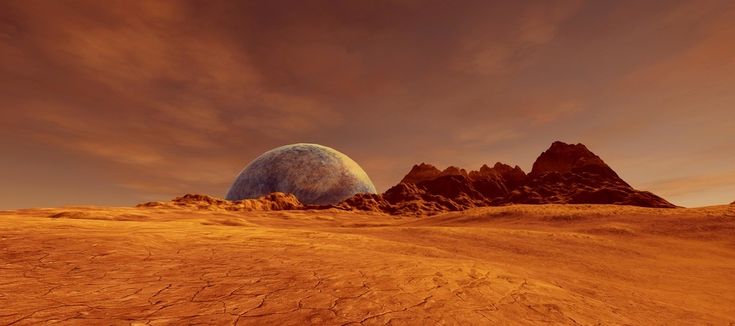
Mars has always been a focal point of curiosity and speculation about the potential for extraterrestrial life. The red neighbor has fascinated us for centuries, not just as in our solar system but as a potential cradle for life. Though its surface is barren today, new research suggests that Mars was once like our Earth. A groundbreaking study by Harvard University reveals that 3.9 billion years ago, the planet had a magnetic field much longer than previously thought. This protective shield could have allowed Mars to maintain a thick atmosphere and liquid water that are crucial for life to exist.
The Role of Magnetic Fields in Protecting Planets
How Magnetic Fields Safeguard Atmospheres
Magnetic fields act as shields for planets, deflecting harmful solar winds and cosmic radiation. It makes the planet tenable. Without this protection, a planets atmosphere can be stripped away, leaving the surface exposed to dangerous solar radiation. For any planet hoping to support life, a magnetic field is essential to maintaining a stable, life-sustaining environment.
The Critical Role of Earths Magnetic Field in Supporting Life
Earths magnetic field is one of the reasons life has thrived for billions of years. It preserves the atmosphere by preventing solar winds from eroding essential gases, including oxygen and water vapour. Earths magnetic shield also protects against radiation that could harm living organisms. If Mars had a similar protective field in the past, it raises questions about its potential to have supported life.
Mars Lost Magnetic Field: What We Knew Before
Previously, scientists believed that Mars lost its magnetic field around 4.2 billion years ago, leaving the planet vulnerable to atmosphere stripping by solar winds. This loss marked the beginning of the planets transformation from a potentially habitable world to the cold desert that we see today. Without the shield, Mars atmosphere was gradually stripped away by solar winds, leaving behind the thin, carbon dioxide-rich atmosphere that exists today.
The New Harvard Study-A Game-Changing Discovery
Findings on Mars Magnetic Field Longevity
Recent research from Harvard suggests that Mars magnetic field may have persisted longer than previously thought. The Harvard study challenges previous assumptions, revealing that Mars retained its magnetic field until 3.9 billion years ago. Using advanced simulations and data from Martian meteorites, the study reveals that localized magnetic fields could have provided temporary protection in specific regions of the planet, extending the window for potential habitability.

Why This Extends Mars Habitability Timeline
The new timeline overlaps with the period when life was first taking hold on Earth. If Mars magnetic field lasted longer, it could mean that the planet retained its atmosphere and surface water for millions—or even billions—of years. This drastically increases the likelihood that microbial life could have emerged and thrived during this period. This discovery fundamentally alters our understanding of Mars history.
Life on Mars?
Unpacking the Implications
Magnetic fields play a vital role in creating habitable conditions. During the time when Mars had a magnetic field, its environment may have been similar to early Earths. With liquid water, a thicker atmosphere, and protection from radiation, Mars could have provided a safe haven for simple life forms to emerge. Could we one day find evidence of ancient Martian microbes?
How Mars Transitioned From Habitable to Hostile
The Loss of the Magnetic Field
Mars likely lost its magnetic field due to the cooling of its core, which disrupted its dynamo effect—the process responsible for generating a planets magnetic field. Without this protective shield, solar winds stripped away its atmosphere, causing the planet to lose its liquid water and become inhospitable.
Solar Winds and Atmospheric Stripping
Once Mars lost its magnetic field, solar winds eroded the atmosphere, stripping away water and other essential gases. This process left the planet dry and unable to sustain life as we know it.
Earth vs. Mars: Two Worlds, Two Fates
Mars and Earth were once similar in their early development, but their paths diverged dramatically. While Earth retained its magnetic field and evolved into a lush, life-filled planet, Mars lost its protective shield and became a barren wasteland. Understanding these differences provides valuable insights into what makes a planet habitable.

Revolutionizing the Search for Alien Life
This discovery has profound implications for astrobiology. If Mars was habitable billions of years ago, similar conditions might exist—or have existed—on other planets. The search for life beyond Earth becomes even more promising with this new perspective.

How Scientists Study Magnetic Fields on Other Planets
The Science of Paleomagnetism
Paleomagnetism involves studying the magnetic properties of ancient rocks using satellite data, meteorite analysis, and simulations. NASAs MAVEN spacecraft, for instance, has provided critical insights into Mars atmospheric loss and remnants of its magnetic field. It has determined the history of a planets magnetic field. By analyzing the orientation of magnetic minerals, scientists can infer the presence and strength of past magnetic fields.
Martian Meteorites: Clues From Space Rocks
Meteorites ejected from Mars provide a unique opportunity to study the planets magnetic past. These rocks often contain magnetic signatures that help researchers piece together Mars geological and magnetic history.
Could Mars Have Hosted Microbial Life 3.9 Billion Years Ago?
The conditions on Mars 3.9 billion years ago with a magnetic field in place, Mars may have had a stable climate, liquid water, and a thick atmosphere. Warmth, liquid water, and protection from radiation could have created a haven for primitive life forms. If microbial life existed on Earth during this time, its reasonable to speculate that Mars could have been similarly hospitable.
Lessons From Mars - Protecting Earths Magnetic Shield
Mars serves as a cautionary tale for Earth. The story of Mars is a reminder of the importance of Earths magnetic field. Without it, our planets atmosphere would be vulnerable to solar winds, and life as we know it would be at risk. This discovery underscores the need to understand and protect Earths magnetic shield. Understanding Mars fate can help us better prepare for challenges like magnetic pole shifts.
Challenges in Proving Past Life on Mars

Proving that life once existed on Mars is a daunting task. Fossilized microbes, if they exist, would be microscopic and potentially buried under layers of rocks. The planets harsh surface conditions and billions of years of erosion make it difficult to uncover clear evidence. Distinguishing biological signals from geological ones is an ongoing struggle for researchers.However, ongoing missions by NASA and other space agencies aim to resolve this mystery.
Future Mars Missions and Their Goals
Upcoming missions, such as those by NASAs Perseverance rover and ESAs ExoMars, aim to collect samples and search for biosignatures on Mars. These missions could provide direct evidence of past life or clues about Mars magnetic history.
What This Discovery Reveals About Planetary Evolution
Mars magnetic field evolution sheds light on the interconnected factors that determine a planets fate. From core dynamics to solar interactions, understanding Mars helps scientists piece together the puzzle of planetary habitability across the universe.
Conclusion
A New Perspective on Mars Habitability
The discovery of Mars prolonged magnetic field timeline reshapes our understanding of its history and potential for life. It suggests that Mars was once far more Earth-like than we imagined, with the potential to support life. It not only enhances our exploration of Mars but also offers valuable lessons for protecting Earth and searching for life on other planets. As we unlock more secrets of the Red Planet, we inch closer to answering one of humanitys most profound questions: Are we alone in the universe?
FAQs
- Why is Mars magnetic field significant?
It suggests the planet could have had conditions suitable for life billions of years ago. - How do magnetic fields support life?
They protect atmospheres and block harmful radiation, creating stable environments for life. - What caused Mars to lose its magnetic field?
Mars core cooled over time, stopping the dynamo effect that generated the field. - What evidence supports life on Mars?
The extended magnetic field timeline and signs of liquid water point to possible habitability in the past. - Whats next for Mars exploration?
Future missions will focus on analyzing rock samples and searching for signs of past life.